DREAD IT
Team: 11 developers | Genre: | Engine: Custom Engine | Role(s): Level Designer and User Researcher | Duration: Sept ‘23 - Aug ‘24
Overview:
DREAD IT is a top-down horror strategy game where players must use traps and cunning to outwit and exorcise monsters in various haunted areas.
As one of the few designers on the team and the one in charge of developing levels and doing user research, I helped build the physical spaces of the game, run playtests, and compile data for bug fixes and gameplay iteration.
My Role:
I served as a level designer from pre-production to full release, designing the playable space of the first half of the game, the first two encounters, and providing support to other areas of the level. I initially worked alongside one other level designer before forming a strike team of four after the first year of development.
I focused primarily on strong compositions and visually impactful areas, crafting the most artfully engaging play space possible.
Project Summary:
Balancing Tension & Clarity - Ensured the player could strategize and plan intelligently while remaining tense and scared.
Cross-Discipline Collaboration - Coordinated with artist and programmers directly on level assets and mechanics to ensure consistency.
System Synergy - Designed spaces around multiple new systems and mechanics created throughout development.
Early in development, I mainly worked on concepts and paper drafts for levels, due to the fact that engine for the project was actively being built during development.
Prototypes for gameplay concepts were built in Unity for the first leg of the project, before ultimately being tested and finalized in the custom engine.
Early Development

Many initial concepts were scrapped, such as specific points for scares and chase scenes, well as the idea of set end location for the level.

Design Process
As we got into the custom engine, the full breadth of enemy AI and the trap functionality had yet to be tested, so the levels changed drastically between test cycles.
Early levels were far too large, with players burning out during the long chase sequences quickly. They were also very winding and confusing to players, which caused further frustration.
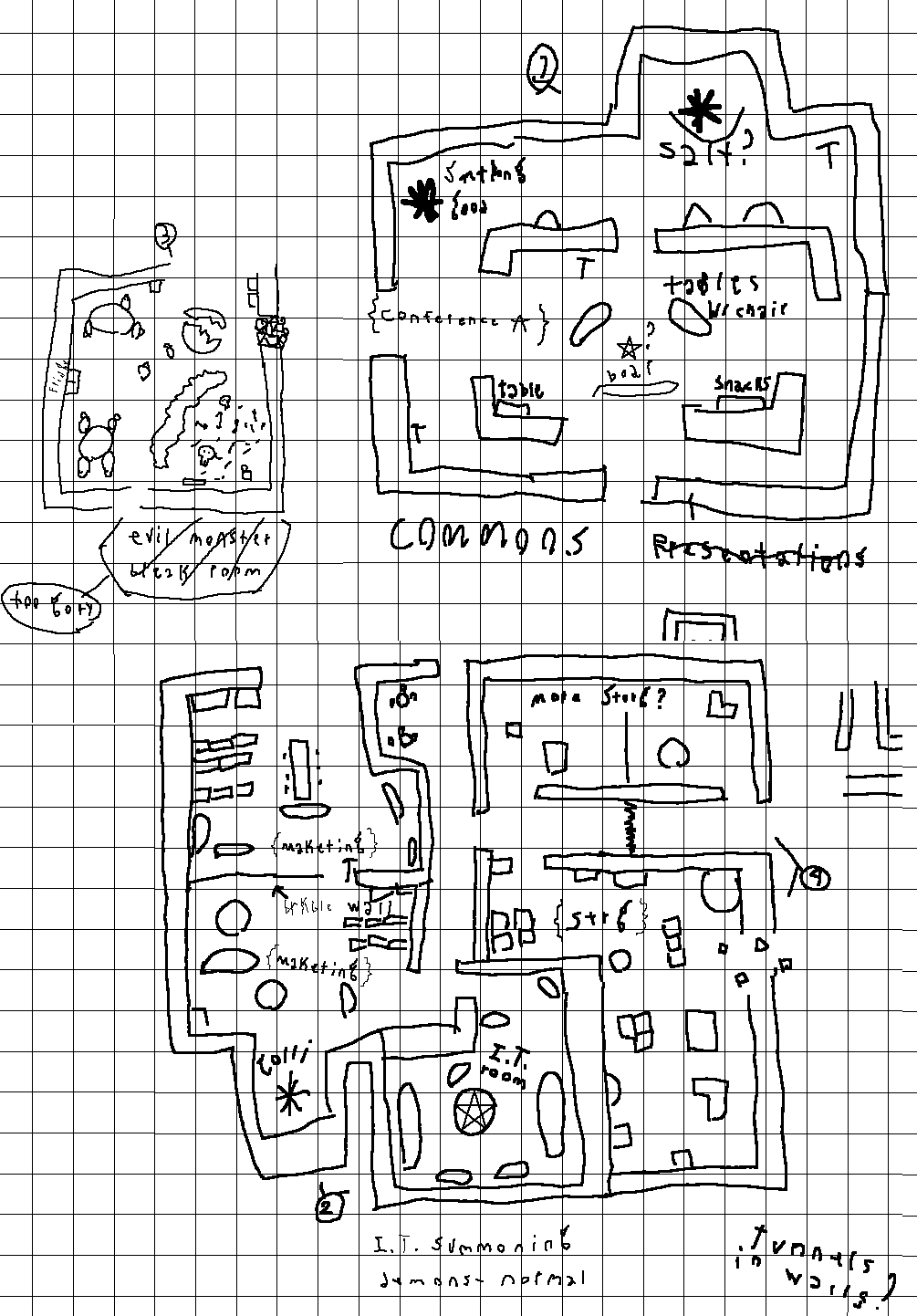

Rough maps for level 1

Initial layout for level 1 — later shortened and made into level 2
Frequent testing helped to refine my sense of scale for the level, carving away sections until a simple, solid layout was landed on.

Level 2 blockout
Along with the scale of the level, complexity was also a constant issue— my intention with each level was to have players feel confined and slightly disoriented by twisting hallways. However, this design conflicted with the intent to have players strategize with their traps and play confidently around the monster.
Finding the right balance between clarity and confusion in the level design was a constant process, but was necessary for capturing the ideal experience the team envisioned.

Level 2 final layout
Frequent testing helped to refine my sense of scale for the level, carving away sections until a simple solid layout was landed on.
The final layout was also tricky to determine due to the development of the mechanics- everything was being made in parallel on tight deadline, I wasn’t fully knowledgeable on how each mechanic would work until they were implemented in the level.
Constant communication was necessary for the level to be finished in an adequate state; I needed to check with multiple members of the CS team to properly implement objects, understand how the monster collision system acted in certain scenarios, and with design on how each player tool worked.
Reflection
After several months of active development, the game had four main levels, a concise narrative, and several realized mechanics.
As it was the first game on which I was a full-time level designer, my design journey with DREAD IT has helped me learn much; balancing conflicting engagement types and level complexity vs clarity, developing levels relying on mechanics actively being developed, and cross-discipline communication in a professional environment.
